Flight
On October 9th, 1903, the New York Times published an editorial titled “Flying Machines which do not Fly.” It predicted that it would take humanity “one to ten million years” to invent a flying machine.
But they got it wrong. Less than 70 days later, at Kitty Hawk, North Carolina, Orville Wright became the first human to take flight.
Flight has always captured the human imagination. The air has had a mythic nature about it - the realm of the gods, free from the constraints and compromise of the ground. We imagined a world where humanity would take over the skies. A world where, much like how the automobile replaced the horse before it, the plane replaces the car.
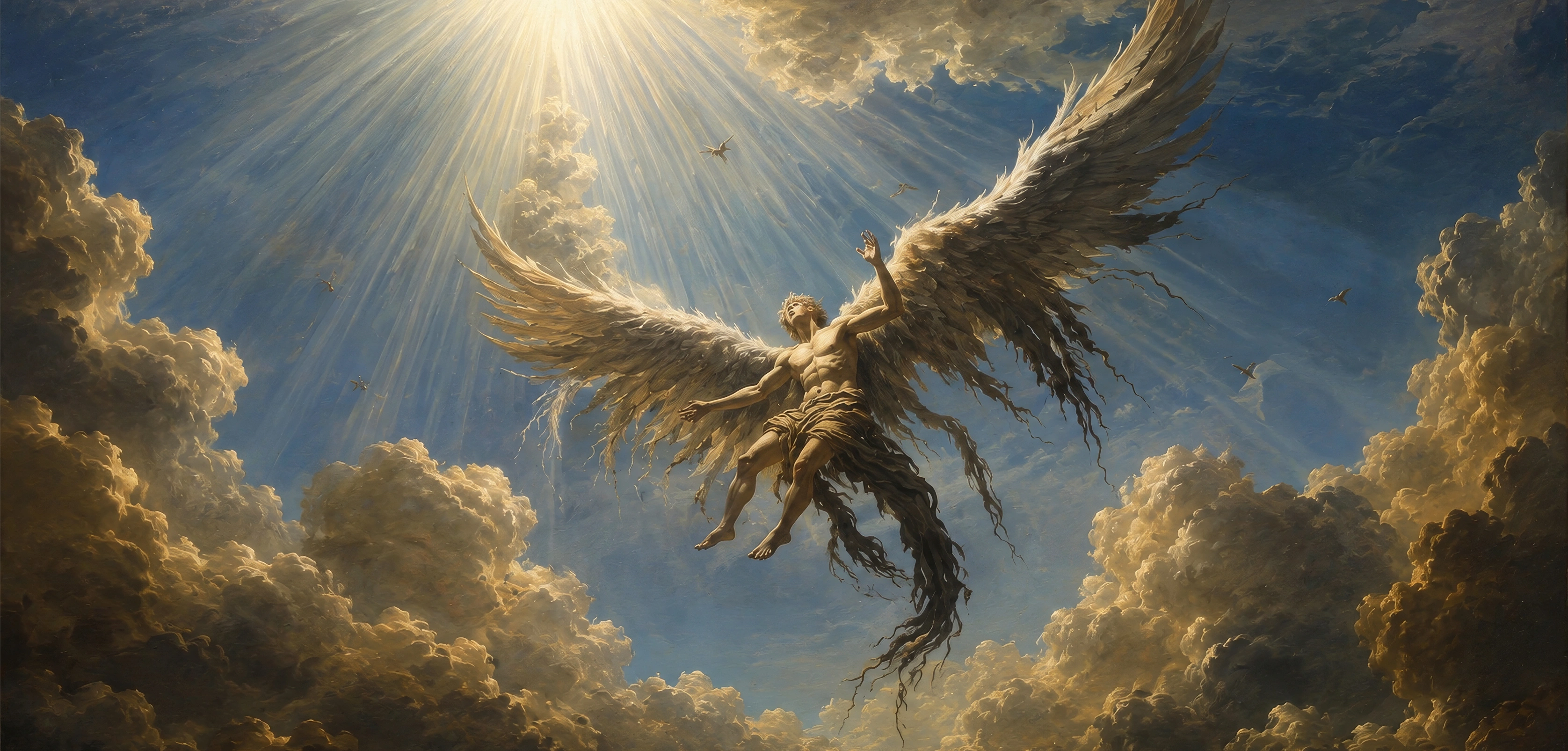
But our ambitions flew too close to the sun. The plane was simply too complex, too inefficient, too expensive. We accepted that the car was here to stay. We accepted that flight is simply not something every human being can experience on a daily basis. We accepted that we have reached the limits of flight. We accepted being tethered to the ground.
I reject that reality. I believe that our ambitions can soar even higher. I believe in a world where all movement is in the air, and that this future is not ten million, not a million, not even a hundred years away. I believe it is possible in the next decade.
The importance of movement
The modern world is built on the ability to move matter quickly and cost-effectively.
When we move matter as products and produce, we call it logistics. When we move living matter, we call it transportation. Both do basically the same thing: move matter from point A to point B as quickly, safely, and affordably as possible.
Today, transport and logistics are treated differently because there is a trade-off between speed and cost. If you want something cheaper, you’ll have to compromise on speed, and the optimal trade-off for goods and people lie on very different ends of the spectrum. People tend to optimize for speed; goods tend to optimize for cost.
However, if we break this tradeoff, we believe that transport and logistics can merge into one industry: Movement.
Movement dictates where we live, how we make a living, who we spend time with and even what we eat.
Consider the grocery store: a logistical marvel stocked with an abundance of goods that would outstrip the imagination of an 18th-century king. A grocery store is typically stocked with 30,000 - 40,000 distinct items, sourced from all across the world. Bananas from a continent away, bread baked in the morning, fish from a port over a hundred kilometers away. Millions of items moving hundreds of millions of kilometers to tens of thousands of stores.
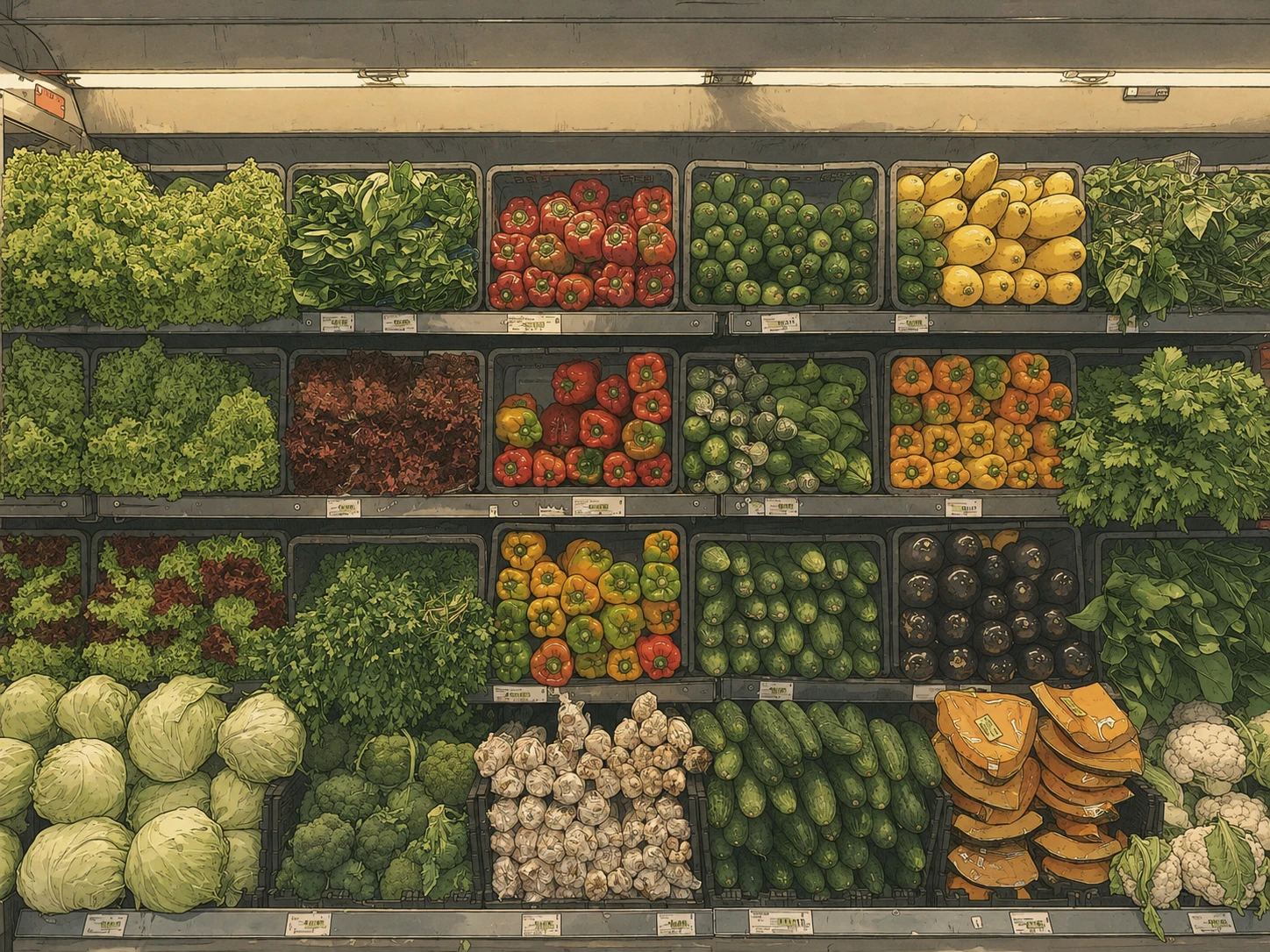
The modern grocery store - and much of life as we know it today - only became possible after the industrial revolution.
The grocery store, ice cream, coffee, even the concept of standardized time - all of these became possible with our ability to move matter as fast and cheaply as possible.To the pre-industrial world, these were impossible luxuries. To us, they’re simply mundane parts of everyday life that we cannot imagine living without.
The speed and cost at which we move determines the size of the world within reach to us.
Draw a circle around yourself representing everywhere you can get in an hour. On foot, that circle is small. A horse makes it better; a train enlarges it again; a car turns it into a metropolitan area. Each increase in speed and decrease in cost pushes the circumference outward, bringing more people, jobs, goods, and ideas inside the circle.
It is the overlapping of these circles that drives economic growth. As people collaborate and share resources more easily, growth compounds in a way it never could in a small town. When we stop increasing the size of these circles, the only way to continue growing is by bringing people closer together - increasing density.
While density fuels economic growth, it also brings traffic and congestion with it. This slows movement down, and reduces the size of each circle. So to continue growing, we must push everything closer together, slow movement down further, and make every circle smaller.
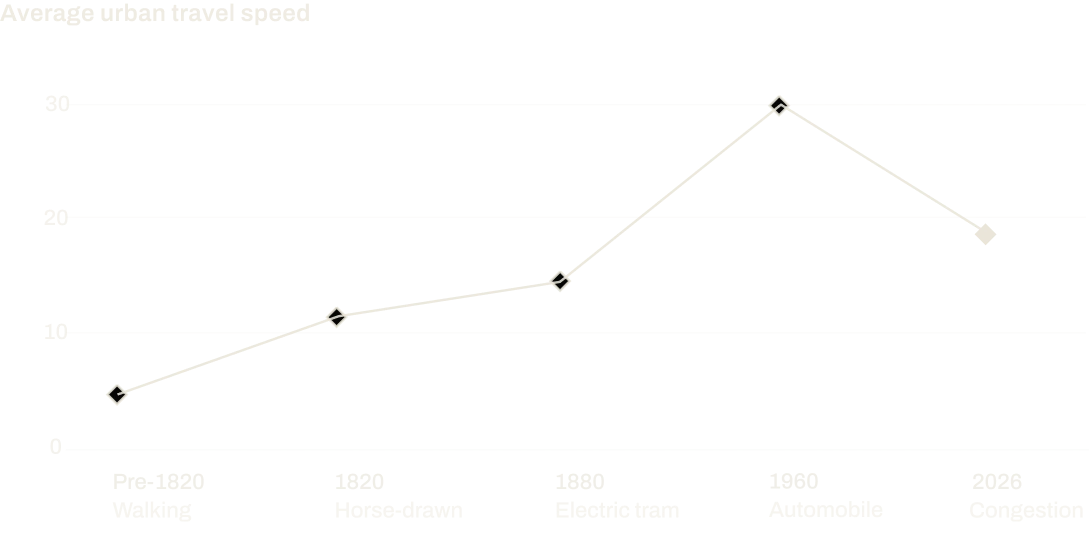
Our roads are filled with these compromises. To stay close to work, you live farther from friends and family. To surf every morning, you give up living near the theatre district. So the circle that was supposed to widen with more speed has instead shrunk to its smallest point yet. We’ve hit the limits of this world.
But I believe we can build a new one. A world that’s just as wondrous and alien to us today as today’s world would be to someone from 1820. A world where goods move as freely as information does today; a world where flying is cheaper than taking the bus; a world without compromise.
To build this world, we just need to solve one thing. We need to move faster.
Scientific revolutions are inaugurated by a growing sense... that an existing paradigm has ceased to function adequately in the exploration of an aspect of nature to which that paradigm itself had previously led the way."
.webp)
Even after a hundred years, aviation is still a bespoke affair that needs a small army on the ground for every departure.
A World of Flight
The thing is, we’ve already solved for speed. We invented flight over a century ago.Today, it’s a normal part of life, flying at near the speed of sound, over 20 times faster than a car. Yet for all its apparent normalcy, flight barely exists as a mode of transport. Less than 1% of all movement is in the air, with land and sea capturing the remaining 99%. Flying is just too expensive.
But what actually makes flight so expensive? The interesting story is that moving mass through the air isn’t actually more expensive than road - in fact, planes should be a much cheaper way to move people and goods. The problem lies in their weight.
If we look at freight transport, a cargo aircraft with a maximum takeoff weight (MTOW) of ~350 tonnes costs ~$17/km flown. A truck with a total weight of ~30 tonnes costs~$1.5/km. The plane carries ~10x the payload for ~10x the cost. The difference comesdown to the payload. Out of 350 tonnes, the plane only carries 107 tonnes as payload,less than a third of its weight. By contrast, the truck carries 20 out of 30 tonnes (67%) as payload.
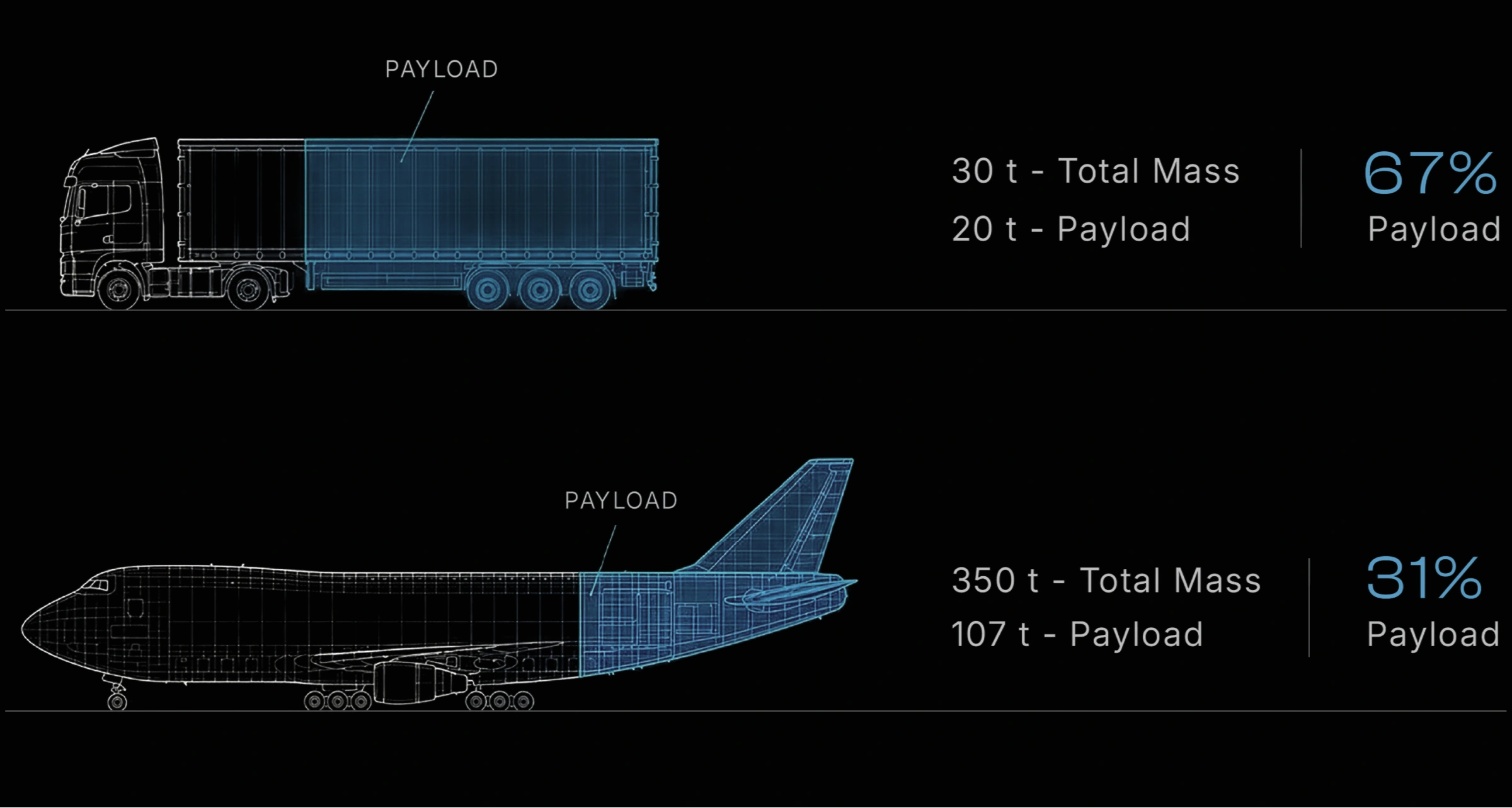
The main reason flying is so expensive is because a majority of the weight a plane lifts is the aircraft itself.1
So we need to make aircraft dramatically lighter. Carry a higher share of that mass as payload, and the air becomes the cheapest way to move anything, and the cheapest way to move things is how you reshape the world.
The aircraft
If the problem is that planes are too heavy, the answer should be smaller, lighter aircraft. So why have we been doing the opposite?
Planes have gotten bigger for basically one reason: the pilot. Every aircraft needs a pilot (or two) and that costs the same whether they fly 5 kilos or hundreds of tons, so you amortise the cost over as much weight as possible. Bigger planes, cheaper flights.
This isn’t unique to planes - it’s how all movement works. Everything that moves has to be chaperoned, so bundling more into each trip is always cheaper. It’s why a truck beats a scooter, a bus beats a taxi, and ocean freighters are the size of city blocks.
In a world where planes can fly autonomously, this amortization is no longer necessary. There is no longer a pilot, so it’s possible to build smaller than a single-seater. Combine this with electric propulsion, which no longer requires large engines to get to high efficiency 2, and the penalty for building small goes away.
In an autonomous world, payload size is set by what needs to be moved, not by what is economical.
A fleet of 4,000 aircraft carrying 5kg each can suddenly compete head on with a 20-ton truck, with a level of versatility and speed that the truck could never reach.
A single-seater craft becomes personal aerial transport that’s more cost-effective than taking the bus, doubling up as a vehicle to carry the heaviest packages that can’t fit in smaller aircraft.
A 5-seater allows families to move together, and has the range to replace domestic routes.
Together, these 3 vehicles can cover more than 80% of all cargo movement and 90% of all human movement3.
Instead of scaling size, you scale volume. Building small is what lets aircraft go from highly bespoke systems to mass-manufactured vehicles. This is the transition the car made that the aircraft previously never could.
When the Model T created a step change in the cost of a car, it started a flywheel. Suddenly millions could afford a car; the increased demand scaled production by multiple orders of magnitude; the new scale of production further brought down cost, bringing in more demand with it. All this, culminating in a world where a car is definitively cheaper than owning a horse.
This is the Model T moment for aviation.
Annual production grows from thousands to tens of millions. Parts become less bespoke, the industry simplifies, and R&D costs get split over larger volumes. Flying becomes cheaper and cheaper every year, until the air is the cheapest way to move atoms, and the cheapest way to move things is how you reshape the world.
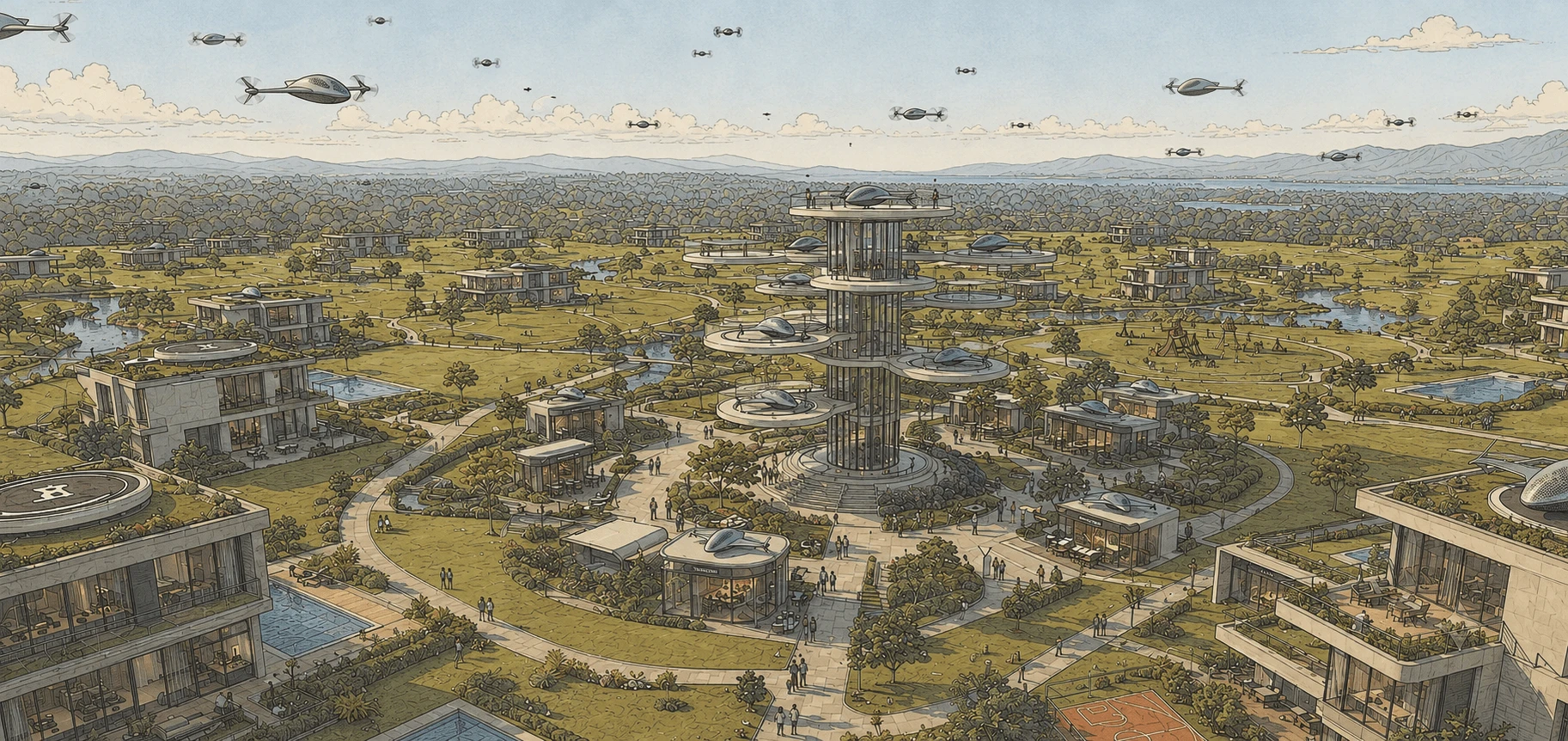
A World without Roads
It’s hard to overstate just how much would change - the end state of this world will be unrecognizable. Much like how nobody in the 1800s could have predicted the world we live in today. I can't predict exactly what comes next either. But I can try.
I believe the world will be built with a few distinct phases in mind. At first, our logistics systems transition to the air. Then people start flying where they need to go. And then the world reshapes itself around this new default mode of movement.
A world where all movement is in the air.
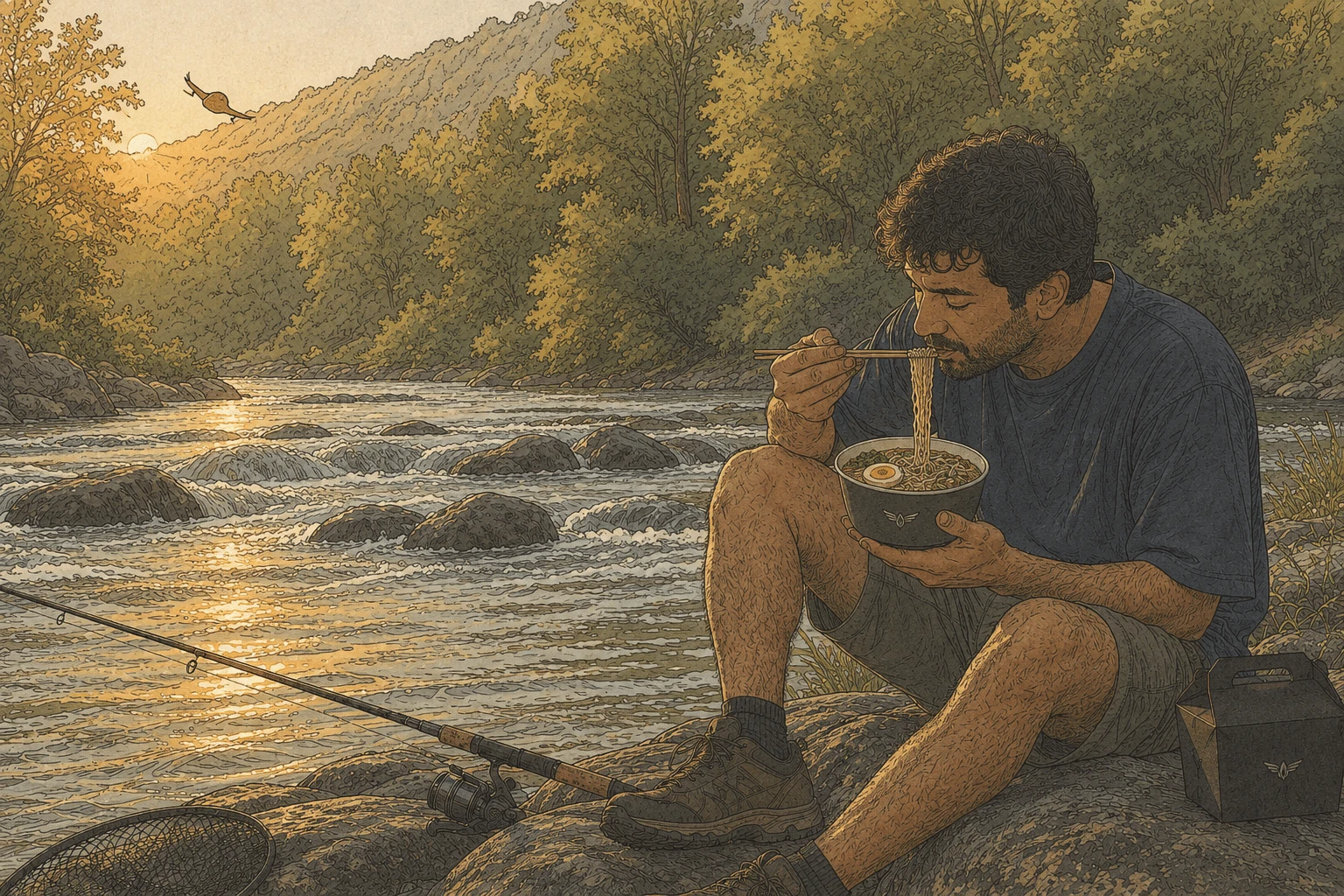
A world where a fresh, hot meal finds you — even in the middle of nowhere.
Phase I
Humanity’s transition to the air won’t be dramatic, it’ll just make everyday life a lot easier.
When you order food, you have more options. That great restaurant that was just outside of your delivery zone is now in, the fries you order taste hot and crispy - almost as if you were eating at the restaurant - and the all-in price is barely higher than what you’d pay in-person.
Soon, you’ll start ordering a lot more than you used to. Out of cheese in the middle of making pizza? It now arrives while you’re cutting the vegetables. Want to see how that new dress looks on you? You can try it at home and just send it back right away if you don’t like it.
When moving goods costs next to nothing, ownership can be thought of differently. Instead of buying 10 sets of forks and spoons for the off chance you have guests, you can just rent them for the evening you do. Instead of throwing your toddler’s toys into storage when they get bored, you can just swap them out for a new one.
Slowly but surely, storage starts to feel less relevant. You realize that most of the space in your cupboards was for items you used less than once a month. When the grocery store is an extension of your fridge, the fridge at home feels like overkill. You begin to reclaim space from things for people. That attic filled with junk would make a great home theatre.
You’ll also see these changes subtly affect the world around you. When the movement of goods becomes so free, it changes the way businesses and supply chains operate.You’ll stop seeing dull warehouses in the city, because there’s no need to store items near customers. You’ll notice that stores have far more variety than they used to, because they can now restock thrice an hour instead of once a day. You’ll notice that the produce you buy is a lot fresher and tastier, because there’s no longer an advantage to increasing shelf life by stuffing them with chemical preservatives.
But this first phase won’t feel that different. Your life will change, but in subtle ways. Many things will just feel easier, but this won’t be a revolution just yet. That will come later.
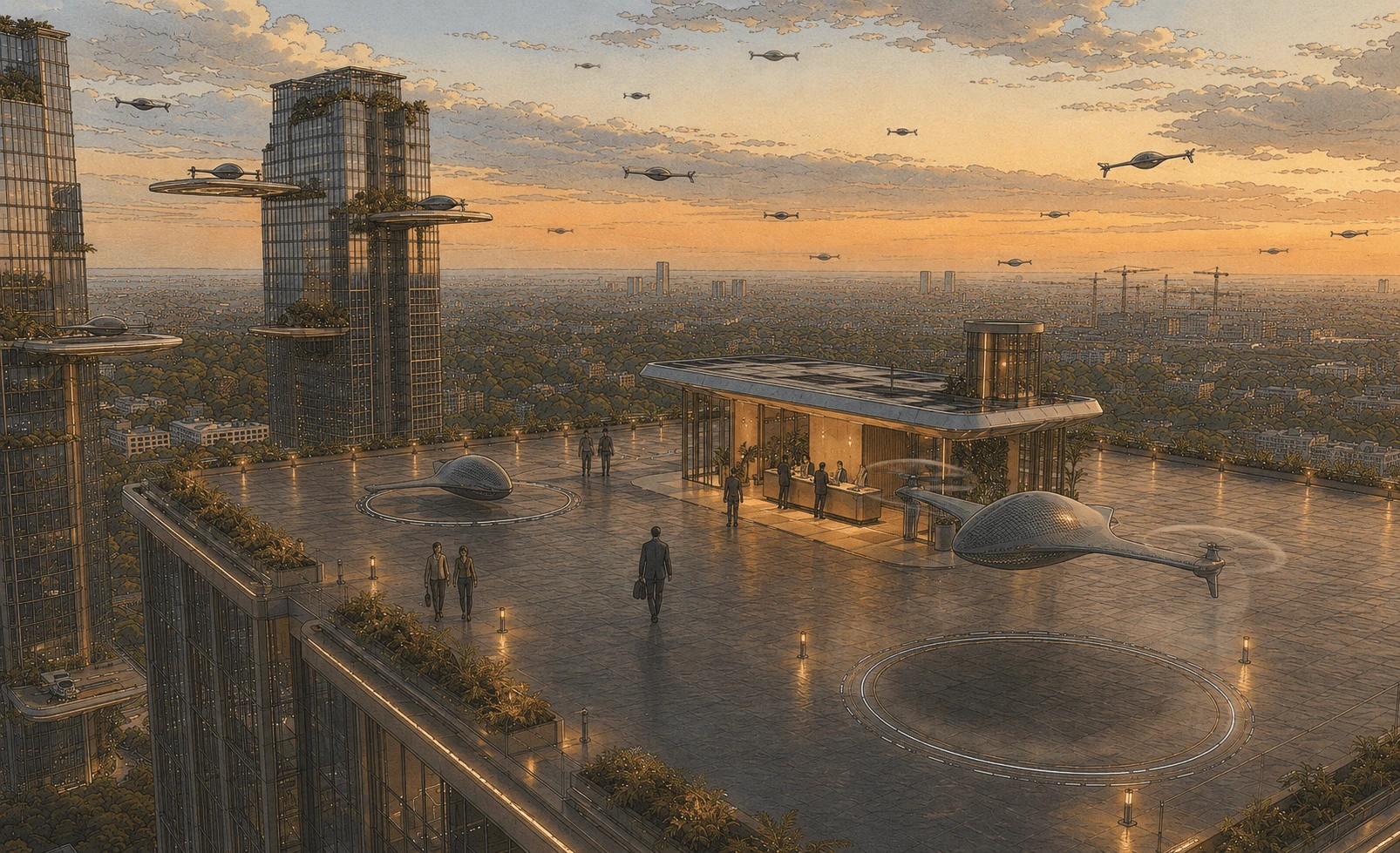
A world where the rooftop becomes the new driveway.
Phase II
If Phase I was removing the cost of moving goods, Phase II is about removing the cost of moving people. This is a world where flying is the cheapest way to move. A world where distances shrink.
Everything feels closer. Your office commute goes from an hour to 10 minutes. That fancy restaurant on the other side of town becomes an option for a Tuesday dinner. Going to visit your parents doesn’t feel like such a chore. This is a world where everyone has access to a personal aircraft infinitely more convenient than even a private jet.
As distance shrinks, multiple cities combine into one. Philadelphia and New York are now part of the same neighborhood. So is Cambridge and London, or Pune and Mumbai. And it’s not just the union of these two points, but everything in between. An hour’s radius around the city center is now mostly open land that is many times more valuable. Much like the industrial revolution, this abundance of land leads to one of the largest infrastructure buildouts in history.
Since space is now so cheap, homes grow more spacious than ever - bringing together a new set of luxuries. Backyards turn into expansive orchards. Most homes have a swimming pool. Inside, libraries, home theaters, or game rooms become a regular feature of middle-class homes.
Outside your primary residence, many luxuries previously limited to the ultra-wealthy become a common part of life. Friday date night is now flying to another city. Owning a different home for the summer and the winter is now the standard.
The world has certainly changed in many ways, but it still feels familiar. We’ve used this technology to augment the way we live, but our way of living is still based on the compromises of the old world.
Over time, that starts to change.
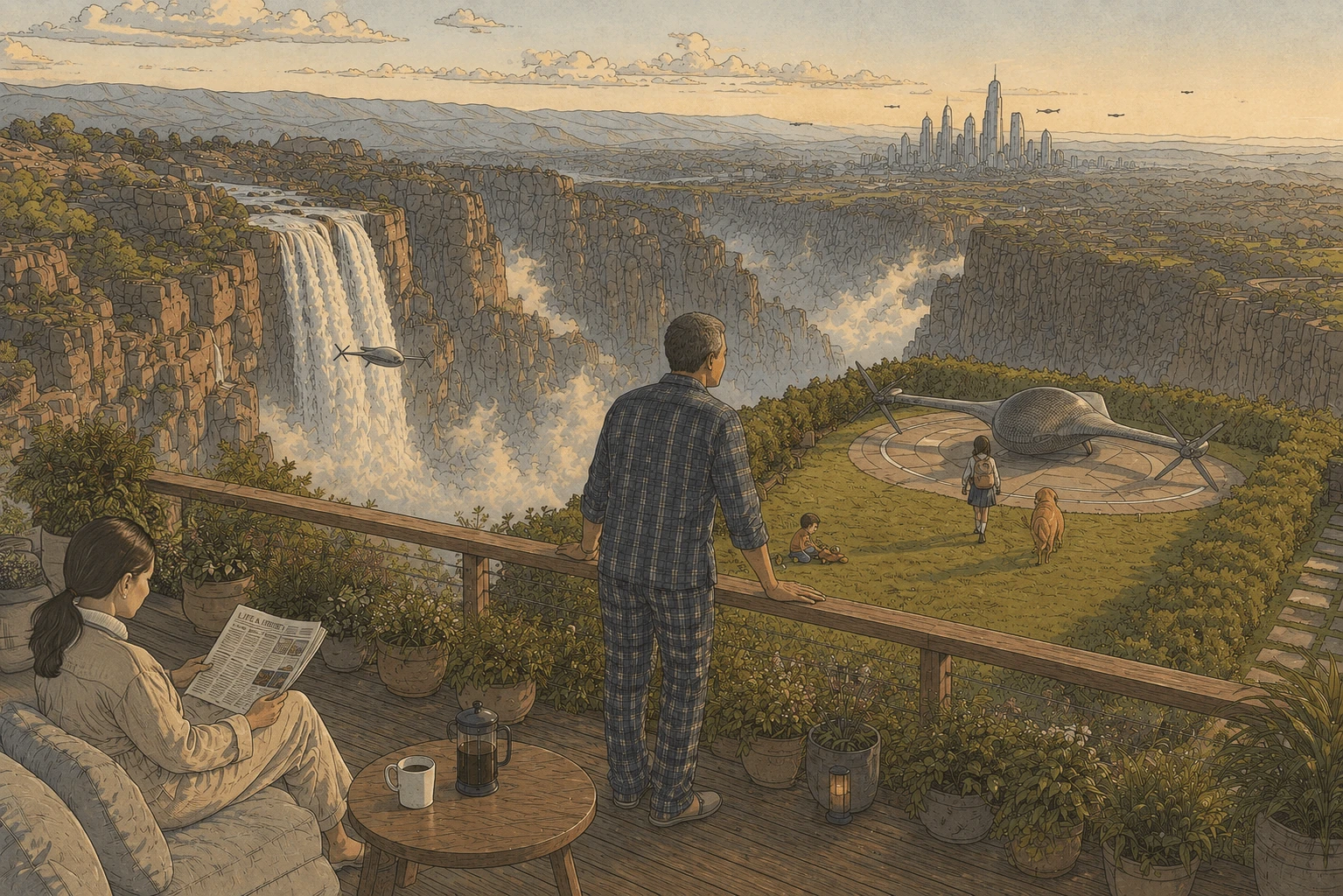
A world where you can now live in peace while being 15 minutes away from the city.
Phase III
A world in which distance shrinks is a world without compromise. So much of the world around us is defined by compromise. You never took your dream job, because it meant spending over an hour getting to work. In an emergency, you go to the nearest hospital - not because it’s the best, but because anything further could be too late.
Eventually, these compromises cease to exist. When movement is free, you can work anywhere in the state without having to shift homes. You can now reach a hundred hospitals in under 30 minutes, so you always go to the best one.
As businesses can access tens of millions of potential customers, they can now afford to specialize in ways they never could before. If your restaurant serves the best tiramisu in the state, why bother competing on dishes where you can’t win? There’s a market for single dish restaurants - one that serves the best tiramisu, and nothing else.
In fact, the concept of a restaurant itself changes. Restaurants today are this awkward mash of two businesses: The kitchen, which is responsible for cooking the best food and making it on time; and the dining area, which is responsible for the ambiance, the music, and the experience of eating food. These are two very different businesses that are forced to share the same space because atoms need to flow freely between them.
All of a sudden, these can separate. You’ll have the best kitchens in the city - each making only 2-3 excellent dishes - feeding into dining areas with the best atmosphere, ample seating, and great music. You can sit across from your partner and have a plate of sushi while they enjoy some pasta - and each dish is at the level of a Michelin star restaurant.
Instead of sending your kids to a school that’s mediocre at every subject, they can go to a different school each day, each specializing in one field of study. Imagine being able to go to Yale for the arts, MIT for the sciences, and Harvard for law.
A larger marketplace also enables niche businesses that could never otherwise exist.The internet partially did this, bringing together communities for the most random interests4, but that too came with compromises. An online business still has to ship products to you. You can’t get a haircut online. In this world, that compromise finally goes away.
This will be a more personal world. If you love animals, you can live in open grassy fields with ample space for all your pets. If you love nature, you can live in lush forests, while still being able to access the rest of your life. If you hate nature, you can live in a concrete jungle, with skyscrapers all around you. There will be stores that sell furniture that perfectly matches your tastes, and arenas for the most eccentric sports.
All this, and countless more wondrous things will be possible. Yet to you, who lives in this world, everything will feel mundane. None of this will feel special anymore, and your expectations will change. A 15-minute commute will feel painful, food that’s not Michelin-grade will taste terrible, and a 10,000 sq ft home will feel too small.
Such is the beauty of humanity. If we could be permanently satisfied, we would never move forward. We constantly look to the future, to the stars, to see just how much further we can go. But once in a while, we look back to the past - just for a fleeting moment - and revel in the world we’ve built.
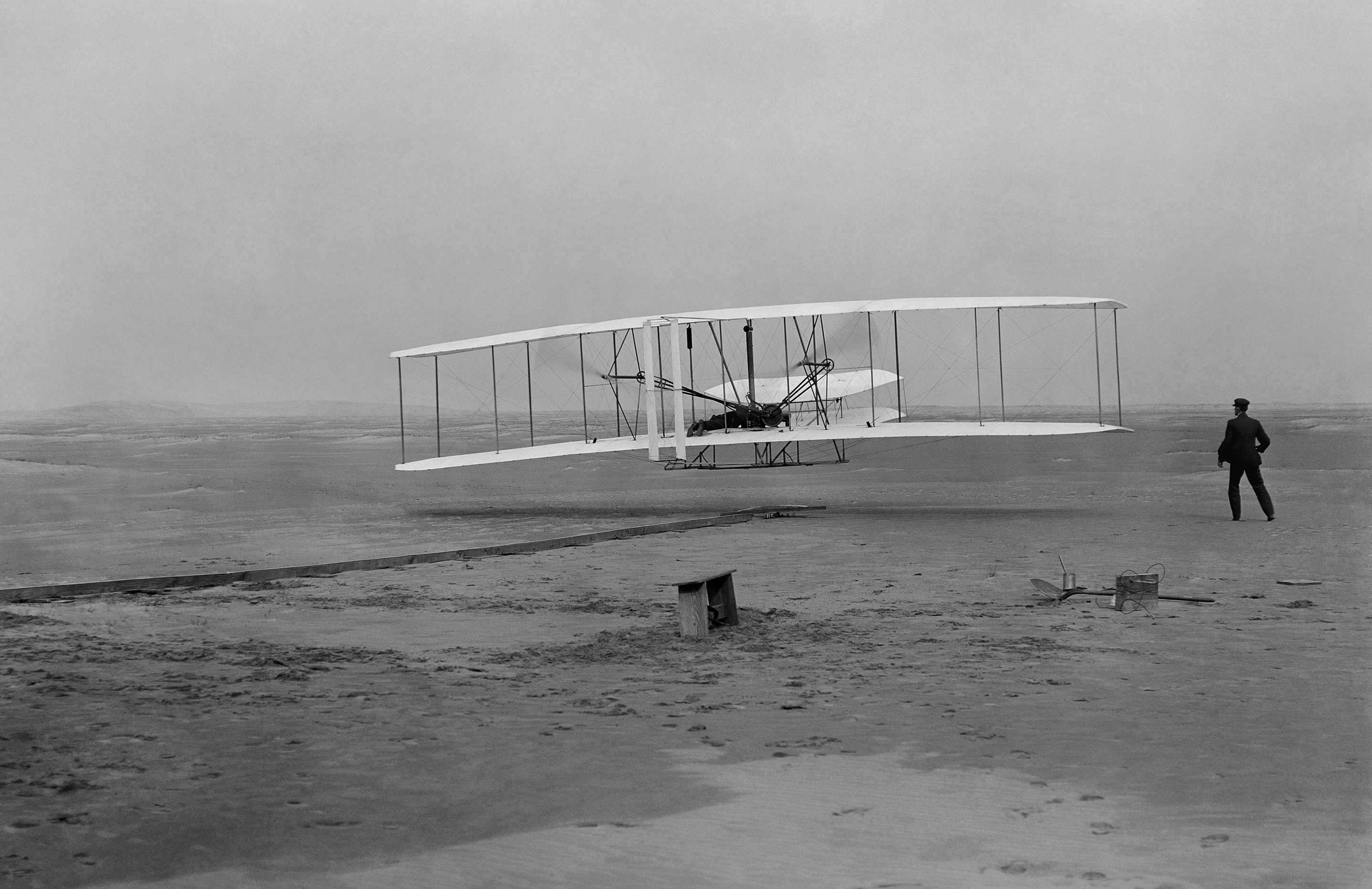
Kitty Hawk, North Carolina — December 17, 1903. The first powered flight lasted twelve seconds.
Building the Future
For some years I have been afflicted with the belief that flight is possible to man. My disease has increased in severity and I feel that it will soon cost me an increased amount of money if not my life.”
— Wilbur Wright
There’s a certain sensible way to innovate - find a problem, understand the constraints and build a solution. The path to a revolution is not so linear. It is built through an obsessive, irrational belief in the possibility of something extraordinary. And when that belief is right, it reshapes the world. After all, you don’t build the future by thinking about the problems of today.
If you wanted to solve for access to information in the 1900s, you’d build more libraries. If you wanted to solve movement in the 1700s, you’d build a better horse. The car, the internet, the aeroplane and all of the inventions that have brought about a revolution were not solutions to problems. They came from something deeper than that: a human need for adventure, for discovery, and a curiosity for what can be made possible.
There’s something magical about the fact that a single technological breakthrough can open up new worlds. Radically light aircrafts are the next one.
I don’t precisely know what this future will look like, but I know this world will be a leap beyond the one we live in. And it won’t be built by the companies that made the last one, it is going to be built by unreasonable people who are willing to spend years making this world real.
That’s why Airbound exists. We are not here to build a better horse. We are here to build the spark that starts the next revolution. And we are looking for the people who want to build it with us.
This isn’t a question of if, only of who and when. We intend to be the answer to both.
2. Both in terms of energy and weight ↩
3. Assuming cost is the only deciding factor. When you factor in the value of time, this number jumps up even
further ↩
4. If you don’t believe me, just search for r/BreadStapledToTrees ↩
Heading
Heading
Lorem ipsum dolor sit amet, consectetur adipiscing elit. Suspendisse varius enim in eros elementum tristique. Duis cursus, mi quis viverra ornare, eros dolor interdum nulla, ut commodo diam libero vitae erat. Aenean faucibus nibh et justo cursus id rutrum lorem imperdiet. Nunc ut sem vitae risus tristique posuere.
Lorem ipsum dolor sit amet, consectetur adipiscing elit. Suspendisse varius enim in eros elementum tristique. Duis cursus, mi quis viverra ornare, eros dolor interdum nulla, ut commodo diam libero vitae erat. Aenean faucibus nibh et justo cursus id rutrum lorem imperdiet. Nunc ut sem vitae risus tristique posuere.
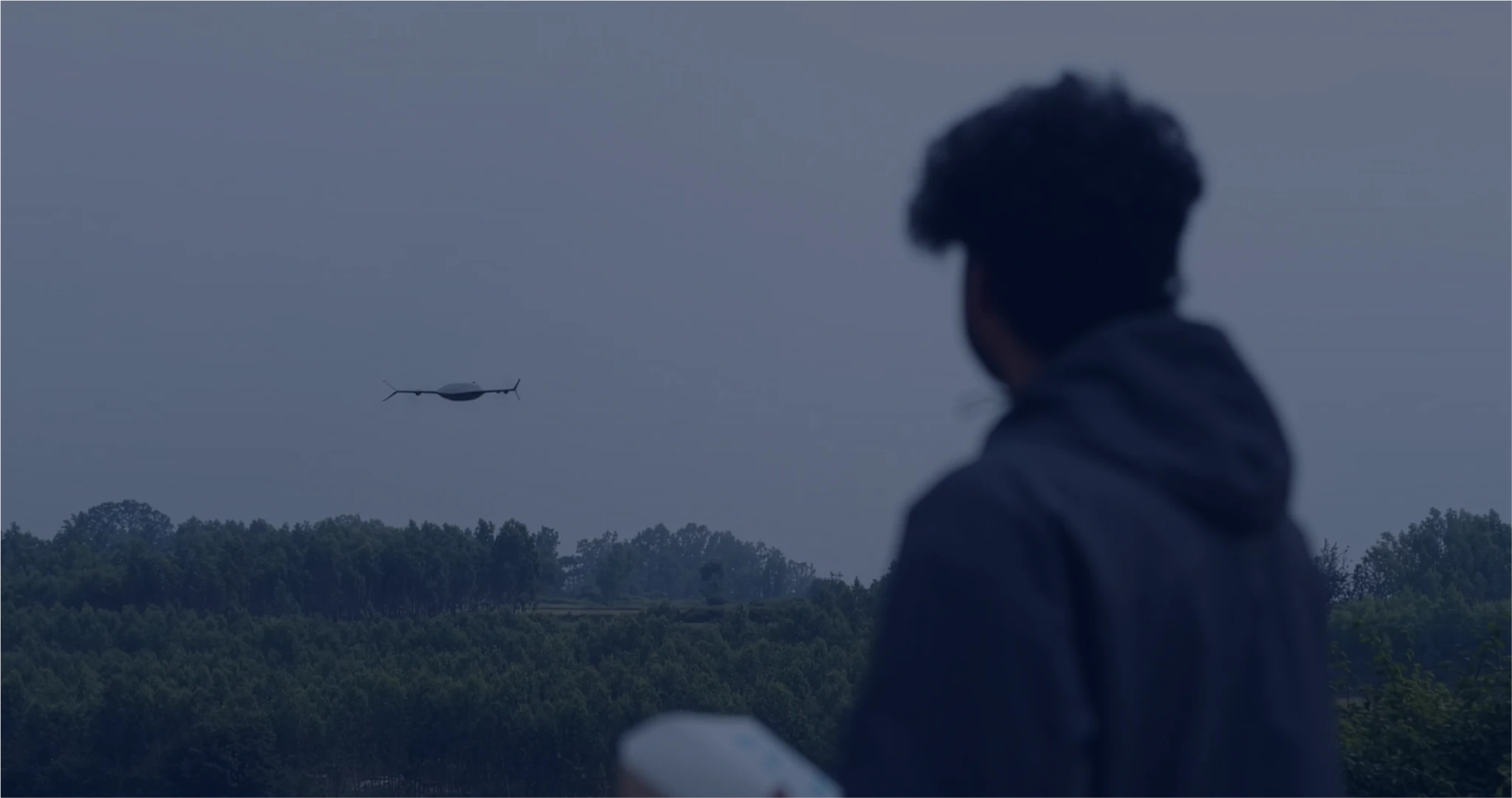
WE ARE
BUILDING THE MOST EFFICIENT AIRCRAFT IN THE WORLD
Join Airbound. Build what others won’t.


WE ARE
BUILDING THE world's most efficient aircraft
Join Airbound. Build what others won't dare.